GE Ice Maker Slow to Make Ice: Water & Performance Checks
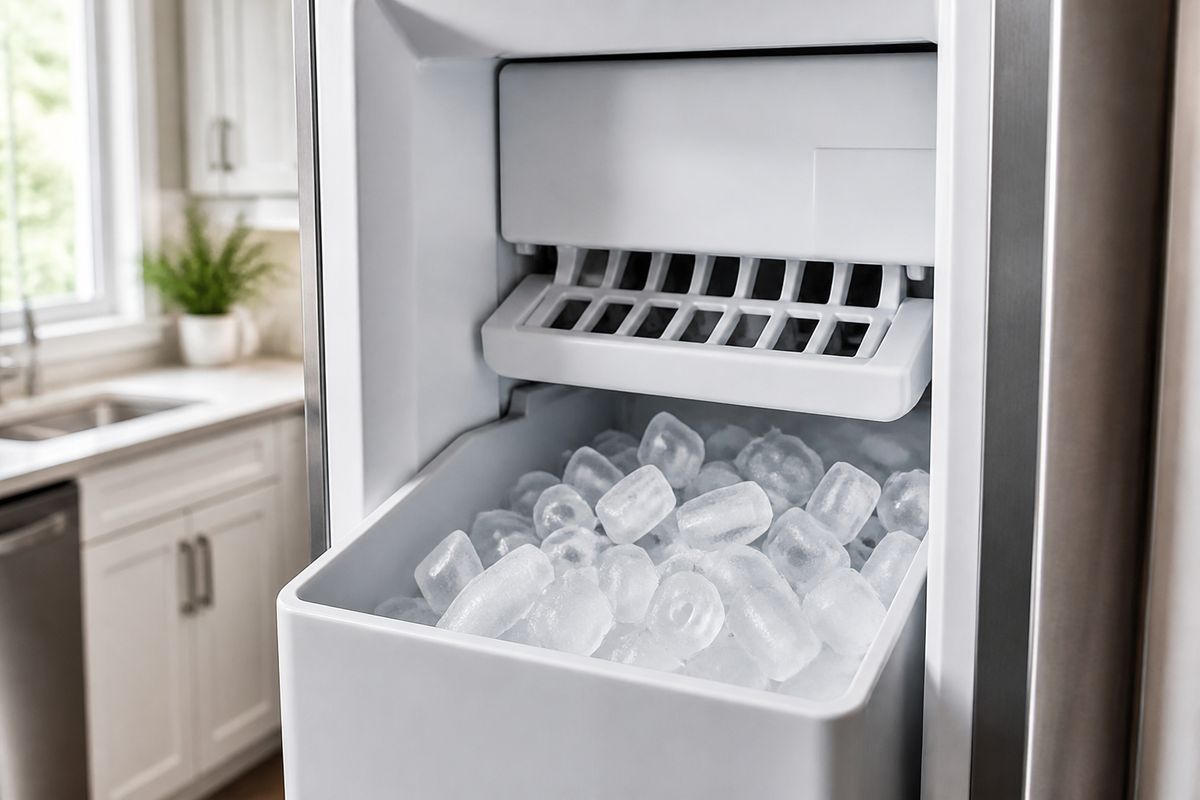
If your fridge is running but your ice bucket feels like it’s barely filling, the problem is often more mechanical than mysterious. When you’re dealing with a ge ice maker slow to make ice situation, the fix usually comes down to two things: whether the freezer can freeze fast enough and whether water can flow strongly enough to refill each cycle. Start with the basics below to pinpoint the limiting step.
For more help, see our Fix a GE Ice Maker Not Making Ice guide.
Start with the Ice-Making Cycle
Confirm the freezer is cold enough
Slow ice production starts with slow freezing. Set the freezer to 0°F (-18°C) (or the factory recommendation on your GE panel). Then give the ice maker time to catch up: after changing temperature, production often improves only after a full cycle because the mold and bin have to reach the right operating conditions.
- Set freezer temperature to 0°F (-18°C) using the control panel.
- Wait at least 4–6 hours for the freezer to recover, especially if you recently added food or opened the door frequently.
- Check the ice maker area—if the room feels unusually warm or the ice compartment looks frosty only in spots, airflow or temperature is likely limiting.
Check whether the bin is already full
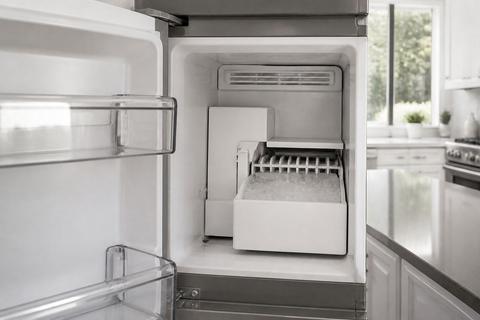
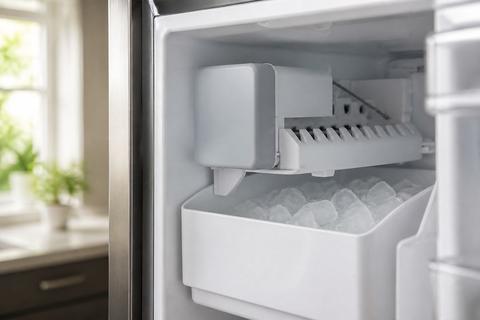
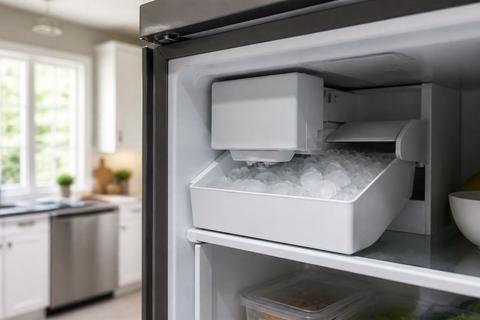
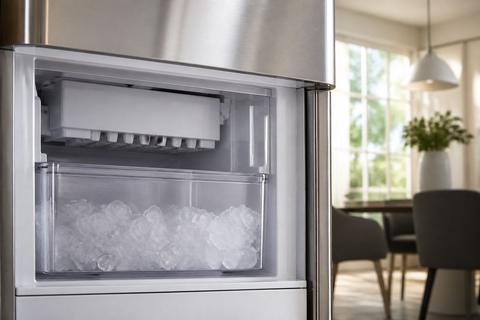
Many GE ice makers stop making ice when the feeler arm (wire bail) is raised. A partially blocked arm or an ice-heavy bin can stop new harvests, making it look like the unit is “slow” when it’s actually pausing.
- Pull the bin slightly out and look for ice that may be holding the mechanism up.
- Locate the feeler arm on the ice maker (the wire bail). If it’s raised, lower it to its normal position.
- Push the bin back in firmly so it engages the ice maker correctly.
Give the maker enough time after a reset
A reset (power cycle or ice maker switch) can trigger a harvest sequence, but the first batch may take hours to fully refill the bin. If you reset the unit and expect instant ice, you can misdiagnose the problem.
- Turn the ice maker off/on using the ice maker control (many models have a switch or “Ice” button).
- After turning back on, wait for the next harvest cycle and subsequent refills.
- If you changed temperature at the same time, prioritize the freezer recovery time before judging performance.
Inspect Water Supply and Flow
Verify the water line is open and kink-free
If water can’t reach the ice maker with steady flow, each cycle stretches longer and ice production slows. A kinked, pinched, or partially frozen line can restrict water even when the refrigerator has power.
- Pull the refrigerator out carefully (enough to access the connection behind it).
- Check the water line for kinks, tight bends, or pinching where it exits the wall or passes through a clamp.
- If the line shows frosting near the connection, inspect for a cold spot that can indicate freezing or restricted flow.
Replace a clogged water filter
A clogged filter is one of the most common causes of slow ice making because it reduces water pressure to the ice maker’s inlet. GE filter systems such as XWF, XWFE, or MWF can starve ice makers when restricted.
- Check your filter age; replace it if it’s been over 6 months or you notice reduced dispenser pressure.
- Install a new GE-compatible water filter tightly seated in the housing.
- Run 2–4 water dispenser cups to purge air, then allow the ice maker to complete the next harvest cycle.
Check for low household water pressure
Even with a clean filter and correct line routing, low building water pressure can slow fill times. The ice maker needs enough incoming flow to refill the mold before freezing begins.
- Dispense water at the kitchen faucet or another nearby tap and note whether flow is weak or sputtering.
- If other water outlets are also low, the issue is likely household plumbing or supply pressure.
- If only the refrigerator’s dispenser/ice is weak, re-check the filter and the refrigerator’s internal inlet connections for restriction.
Look for Freezer and Airflow Problems
Set the freezer to the recommended temperature
A slow ice maker is frequently a freezer-temperature problem. If the freezer is set too warm, water may fill but won’t freeze quickly enough to complete harvest on schedule.
- Set the freezer to 0°F (-18°C).
- Avoid crowding the freezer with items that block the air vents near the ice maker area.
- If the freezer recently warmed (vacation mode off, frequent door opening), wait 4–6 hours for temperature stabilization.
Clear vents and avoid overpacking the freezer
Ice formation depends on consistent cold air circulation. Blocked vents lead to uneven cooling and delayed freezing in the ice mold area.
- Pull items forward so vents aren’t blocked—especially near the back panel where air moves.
- Remove any items pressed directly against the freezer wall vents.
- Leave at least a few inches of clearance around areas where cold air enters and circulates.
Check door seals for warm air leaks
A leaking door seal raises freezer temperature and increases frost/ice variability, which slows ice output. If the door isn’t sealing tightly, the ice maker will struggle even if the fridge is otherwise fine.
- Close the freezer door on a sheet of paper and gently tug it out—resistance should be consistent around the perimeter.
- Inspect the gasket for gaps, warping, or debris that prevents a tight seal.
- Clean the gasket with warm water and wipe dry; if the gasket is damaged, replace it.
Review Ice Maker Hardware and Settings
Make sure the ice maker is turned on
If the ice maker is off, you’ll see delayed or absent production. Some GE models include an on/off switch behind the front cover, and others rely on a control selection that can be accidentally turned off.
- Open the ice maker access area (or refrigerator control panel, depending on model).
- Set the ice maker to ON (or select Ice Maker / Cubed / On on the display).
- If your model has a status LED, confirm it indicates the ice maker is enabled before moving to mechanical checks.
Inspect the fill cup and ejector arm for obstructions
Obstructions in the fill path or a stuck ejector mechanism can slow or halt the harvest cycle. Ice can form in the wrong place, especially if water intermittently freezes in the fill cup.
- Unplug the refrigerator or switch the ice maker off before removing components if your model requires access.
- Check the fill cup area and remove any visible ice chunks that block water entry.
- Locate the ejector arm/harvest mechanism and ensure it can move through its cycle without binding; if it’s held up, clear the blockage and reposition it.
Test for scale buildup or frozen water in the mold
Mineral scale from hard water can restrict the flow and slow heat transfer during freezing. Frozen water in the mold or fill parts also prevents normal cycle timing.
- Look for mineral buildup or chalky deposits around the ice maker mold area.
- If you notice ice where water should flow, allow the unit to warm briefly (or carefully thaw per safety guidance) before clearing ice safely.
- If scale is present, plan a dedicated cleaning/descale cycle using the correct GE ice maker cleaner or an appropriate descaling method recommended for your specific model.
Compare Normal vs. Abnormal Slow Ice Production
Understand when slow ice making is normal
Some delay is normal right after first installation, after a large power interruption, or following a reset/maintenance event. Also, if you only open the door occasionally or the freezer just recovered from being warm, it can take multiple cycles to build a full bin.
- If the ice maker was recently powered back on, allow several hours for a full batch to form.
- If the freezer has been running hot due to stocking or frequent door openings, ice output will lag until temperatures stabilize.
- If you’re producing small amounts consistently over time, you may be seeing “catch-up” rather than a true failure.
Spot signs of a failing inlet valve or thermostat
A weak inlet valve can cause slow fill, while a thermostat/temperature sensor issue prevents the correct freeze cycle. Clues include inconsistent ice production, long intervals between batches, or water that doesn’t reliably freeze.
- If water fills slowly but eventually completes, suspect restricted inlet flow or valve performance.
- If water appears to fill but ice doesn’t properly form, suspect freezer temperature control, sensor behavior, or ice maker control logic.
- If these symptoms persist after fixing filter and freezer temperature, professional diagnosis is needed to confirm valve/thermostat integrity.
Know when the problem points to a refrigerator issue
Sometimes the ice maker is doing its job, but the refrigerator can’t maintain the temperature or airflow needed. System-level issues—cooling performance, fan operation, or control problems—can show up as “ice is slow” even when the water line is fine.
- If the freezer struggles to maintain 0°F (-18°C) despite correct settings, the cooling system may be failing.
- If you hear abnormal fan behavior or notice uneven cooling, airflow issues can prevent consistent mold freezing.
- If multiple refrigeration functions feel weak at once (not just ice), treat it as a refrigerator performance problem rather than isolated ice maker hardware.
What to Do After Basic Checks
Run a simple reset or power cycle
A power cycle can clear stuck ice maker states and restart harvest timing. Use it after you’ve checked obvious blockages, filter flow, and freezer temperature so you don’t reset into the same restriction.
- Turn the ice maker off, then back on using the unit’s control (switch or button), OR unplug the refrigerator for 1–2 minutes if that’s the safest method for your model.
- Plug back in and set the ice maker to ON.
- Allow the next cycle to harvest and refill; if ice never increases, move to cleaning and component-level checks.
Clean the ice maker and water path safely
Cleaning removes scale and buildup that slow water flow and freezing. For models that require it, follow the manufacturer’s cleaner instructions to avoid damaging internal parts.
- If you have a modular ice maker, access the ice tray/mold area and remove visible ice buildup carefully.
- Clean the ice maker surfaces and the path where water enters the mold using only safe, manufacturer-approved methods.
- If scale is suspected, use GE ice maker cleaner designed for your ice system, then run the rinse/clean cycle steps as directed to clear residual cleaner.
When to call for service or replace the unit
If you’ve corrected water flow (filter/line pressure), set the freezer to 0°F (-18°C), cleared obstructions, and cleaned buildup but the unit remains slow, internal components may be failing. At that point, service helps confirm inlet valve performance, control board function, and sensor accuracy.
- Call for service if slow ice continues after filter replacement, freezer stabilization, and ice maker cleaning.
- Ask the technician to check inlet valve flow, temperature control/sensor readings, and ice maker assembly operation.
- Replace the unit only when repair is not cost-effective or components are not recoverable; service will provide the correct diagnosis based on your model.
Frequently Asked Questions
Why is my GE ice maker making ice too slowly?
The most common causes are weak water flow, a dirty or clogged filter, freezer temperature problems, blocked vents, or a partially stuck ice maker mechanism.
How long should a GE ice maker take to make ice?
Many ice makers need several hours to complete a full batch, and production slows further if the freezer is too warm or water flow is restricted.
Can a dirty water filter make the ice maker slow?
Yes. A clogged filter can reduce water pressure enough to slow fill times and delay each ice-making cycle.
What freezer temperature is best for ice production?
Ice makers usually work best when the freezer stays around 0°F (-18°C). Warmer temperatures can slow freezing and reduce output.
If my GE ice maker is still slow after checks, what should I do?
Reset the unit, clean visible buildup, and test water flow again. If production remains slow, the inlet valve, control board, or ice maker assembly may need professional diagnosis.