GE Café Ice Maker Not Making Ice: Fix Eject and Jams
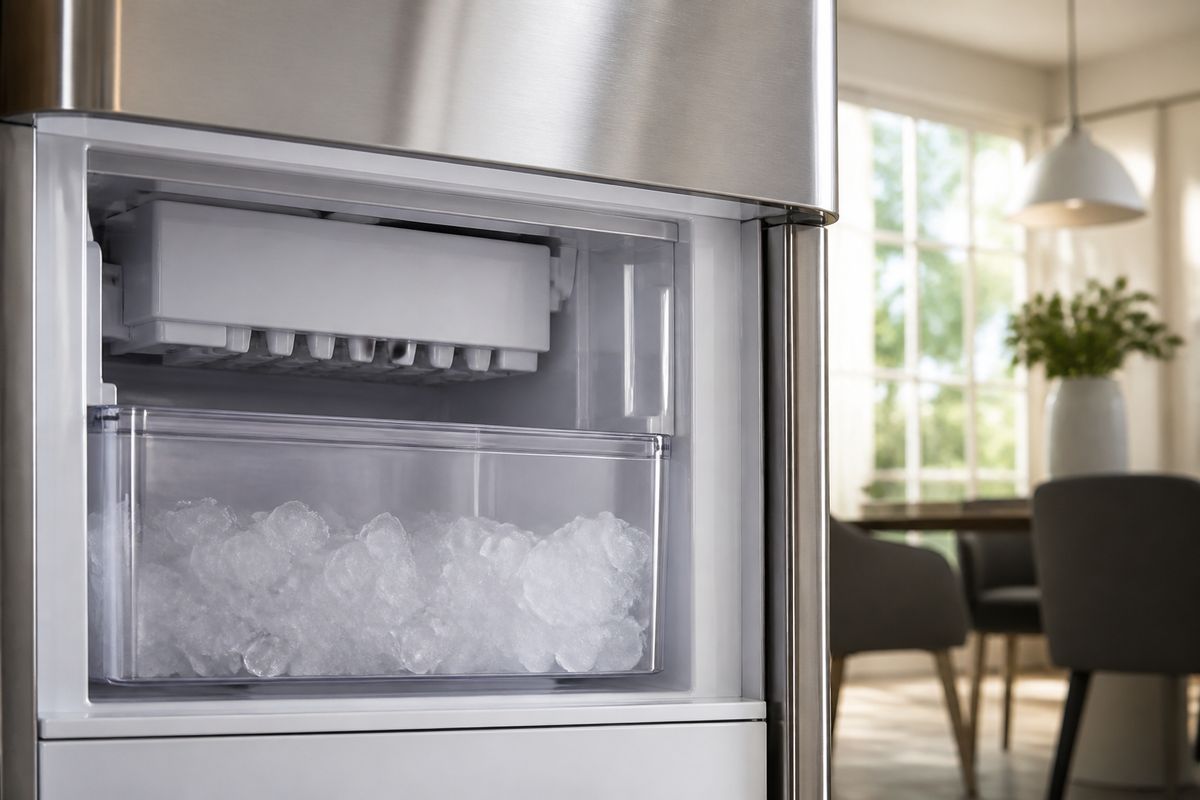
If your ge cafe ice maker not making ice, the problem is almost always easier to pin down than it seems—either the ice maker isn’t running, the freezer isn’t cold enough, or the eject/harvest step is stuck. When ice production starts but ice won’t drop into the bin, a jammed ejector, frozen clumps, or misaligned bin is usually the culprit. Use the steps below to isolate the failure point and restore clean, consistent ice.
For more help, see our Fix a GE Ice Maker Not Making Ice guide.
Start with the simplest checks
Confirm the ice maker is turned on
Start with power and settings. On many GE Café refrigerators, the ice maker can be disabled from the control panel and will stop producing even if the fridge is working.
- Open the freezer and locate the ice maker area (bin/cover).
- On the control panel, press Ice (or Ice Maker) and set it to On. If your model shows a status icon, confirm it indicates ice production is enabled.
- If there is a dedicated ice maker switch on the front cover, slide it to ON.
- If it was recently installed or after a reset, run the ice maker manually once from the unit’s ice controls (if your model offers a manual test/harvest option).
Check the freezer temperature
GE ice makers need freezer cold to freeze water into cubes. If the freezer is too warm, the unit may fill but never complete the freeze-and-harvest cycle.
- Set the freezer to 0°F to 5°F (check the freezer temp display or the thermostat setting).
- Wait 30–60 minutes after changing settings for the temperature to stabilize.
- Look for signs the freezer is struggling: ice melting in the bin, frost patterns that look abnormal, or condensation on interior walls.
Look for a recent power outage or reset
A power loss can interrupt the ice maker cycle and leave it unable to eject properly.
- If the refrigerator lost power recently, turn the ice maker off then back on using the control panel/ice switch.
- Unplugging briefly can also reset some GE Café configurations: unplug the refrigerator for 5 minutes, then plug it back in and enable the ice maker.
- After power restoration, allow a full cycle to run; the first batch may take longer because the system refills.
Why ice gets stuck instead of ejecting
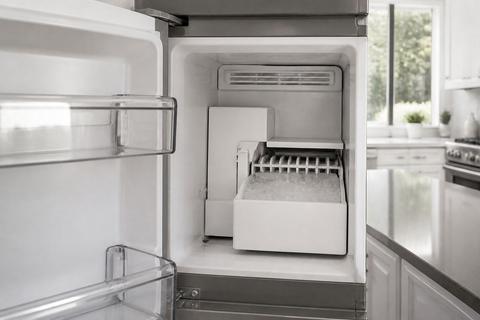
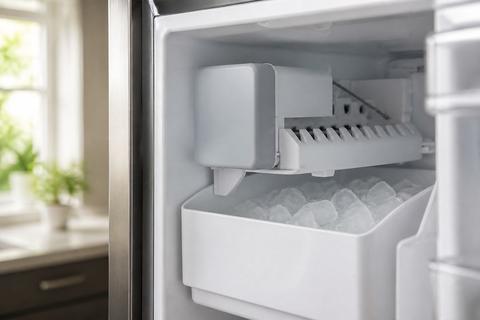
Inspect the ice tray, sweep arm, and ejector mechanism
When the ice maker freezes cubes but won’t dump, focus on the harvest/eject parts.
- Remove the ice bin carefully and set it on a towel.
- Check the ice tray area for cubes blocking movement.
- Move the sweep arm/feeler arm by hand (only if the mechanism is reachable and not forced). On most GE modular ice makers, the feeler arm stops ice production when raised; if it’s stuck up, lower it to resume.
- Inspect the ejector path: ensure nothing is jammed where cubes should drop.
Clear frost, clumps, and frozen cubes
Frost and welded-together clumps commonly prevent the ejector from dumping cleanly.
- Unplug the refrigerator or turn the ice maker off.
- Let the freezer stabilize at a warmer internal condition for 10–20 minutes so frost softens (keep the door closed).
- Use a plastic utensil to break apart clumps in the tray and around the ejector; never use sharp tools that can damage mold surfaces.
- Remove loose ice fragments, then turn the ice maker back on.
Check for a misaligned bin or blocked chute
A slightly mispositioned bin or blocked chute can stop the harvest cycle or prevent cubes from landing correctly.
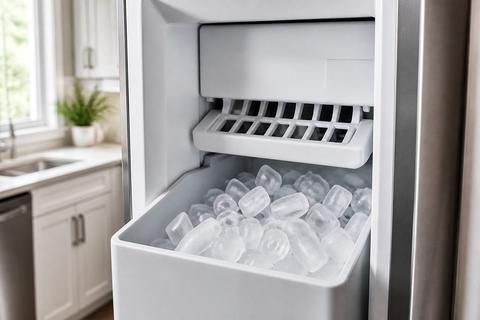
- Reinstall the ice bin fully—listen/feel for proper seating.
- Make sure the bin isn’t tilted, overfilled, or holding the feeler/sensor in a stopped position.
- Check the chute path for ice bridging or an obstruction at the opening where cubes drop into the bin.
How the ice maker cycle works
Understand the fill, freeze, harvest, and dump stages
GE Café ice makers run a repeatable sequence: water fills the mold, water freezes into cubes, the unit harvests (ejects cubes from the mold), then dumps them into the bin and refills.
- Fill: The inlet valve sends water into the mold.
- Freeze: The mold temperature drops enough to freeze cubes.
- Harvest: A motor/ejector mechanism advances to release cubes.
- Dump: Cubes fall into the bin and the unit resets for the next cycle.
Knowing which stage fails speeds up diagnosis—no ice points to fill or freeze problems; ice but no dumping points to harvest/eject.
Spot where the cycle is failing
Use symptoms to identify the likely stage without guesswork.
- If there is no ice at all, suspect the ice maker being off, freezer too warm, no water entering the mold, a clogged filter, or a failed inlet valve/sensor.
- If ice forms but doesn’t drop, suspect a jammed ejector/sweep arm, frost buildup, or harvest-cycle failure.
- If you hear water sounds but no cubes appear, freeze stage is failing (freezer temperature, airflow issues, or a faulty freezing component).
Know which symptoms point to a motor, valve, or sensor issue
Different failures leave different clues.
- Motor/ejector issue: cubes remain stuck in the mold or tray; the unit may cycle but never successfully dumps ice.
- Inlet valve issue: you may hear a fill attempt, but the mold stays dry, or ice production never starts.
- Sensor/control issue: the unit stops mid-cycle, shows an ice-related status indicator, or refuses to harvest/dump even after jams are cleared.
Troubleshoot water and cooling problems
Verify water supply and inlet valve flow
If water isn’t reaching the mold, no freeze and no ice.
- Locate the refrigerator’s water feed (behind or at the wall connection) and ensure the supply is turned on.
- If you have access to the inlet line, check for kinks or freezing points along the line.
- Listen for water flow during a cycle; if water doesn’t reach the mold, the inlet valve or supply line is the likely failure.
- Inspect the ice maker connections if you recently moved the refrigerator—loose connections interrupt flow.
Check the water filter and replace it if needed
A clogged filter starves the ice maker even when everything else is working.
- Find the GE Café water filter (commonly a cartridge like GE XWF/XWFE/MWF series).
- If it’s past 6 months or flow has slowed, replace it with the correct GE part.
- After replacing, run the ice maker through a few dispense cycles to purge air and restore full water flow to the mold.
Look for warm freezer air leaks or door seal issues
Cold loss stops freezing and can also cause frost problems that lead to jams.
- Close the freezer door on a strip of paper. If the paper slips out easily, the seal may be weak.
- Inspect door gaskets for cracks, gaps, or food debris preventing a tight seal.
- Check vents inside the freezer for blockages; a blocked air channel leads to uneven cooling and incomplete freeze cycles.
Model-specific GE Café and refrigerator checks
Use the control panel or settings to enable ice production
GE Café models can disable ice through the UI or ice options.
- On the refrigerator display, press Ice / Ice Maker controls and set to On.
- If your unit includes a Sabbath Mode, Energy Saver, or Ice Off setting, disable it so ice production can run normally.
- Watch for an ice status indicator; if it changes to an off/paused state, fix that setting first before troubleshooting parts.
Find the ice maker shutoff switch or sensor
A shutoff arm or sensor prevents ice production when it thinks the bin is full or the tray isn’t ready.
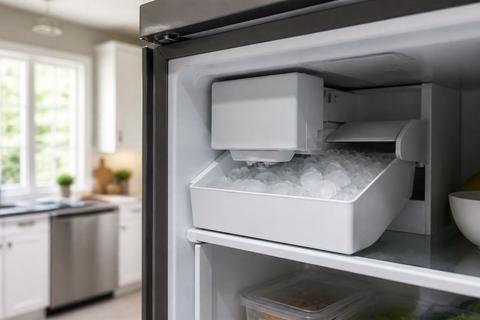
- Remove the ice bin and locate the shutoff feeler arm (often a wire bail).
- If the arm is stuck raised, gently lower it so it sits where the sensor can detect bin presence correctly.
- If the arm is obstructed by ice debris, clear it and reinstall the bin.
Know when the issue is part of a larger refrigerator problem
Sometimes ice maker symptoms are caused by the refrigerator’s cooling system or airflow.
- If multiple freezer compartments are warm or you see persistent frost/ice patterns inconsistent with normal operation, treat cooling first.
- If the refrigerator recently had an HVAC/thermostat issue or the freezer runs warm after the door opens frequently, fix airflow and sealing before replacing ice maker components.
- If the unit shows error codes on the display, follow the code-specific cooling guidance in your model documentation.
When cleaning or descaling helps
Clean mineral buildup around the mold and ejector parts
Mineral scale reduces heat transfer in the mold and can fuse ice, causing jams and weak harvest.
- Turn off the ice maker and empty the bin.
- Look for white/gray scale around the mold surface and near the ejector.
- Wipe accessible areas with a damp cloth, then remove loosened debris using a plastic tool to avoid damaging surfaces.
- Re-enable ice production and observe whether ejection improves after the next few cycles.
Use approved cleaning methods for GE ice makers
Use the correct cleaner to prevent damage and restore proper flow.
- Follow the cleaner instructions specific to your GE ice maker type.
- Use a dedicated ice maker cleaner (not random descalers not intended for ice systems).
- Run the cleaning procedure through the ice maker until the system indicates completion, then rinse as directed to clear residue.
- After cleaning, allow normal cycles to resume; ice quality and release should improve.
When descaling applies to GE Opal models instead
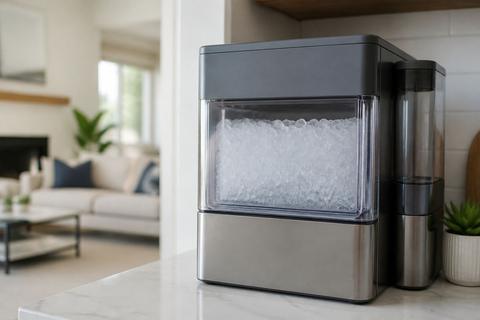
GE Opal nugget ice makers (countertop units) have different maintenance needs than standard refrigerator cube makers.
- For Opal, reset by unplugging for several minutes, then restarting the unit.
- Run the Clean cycle when prompted or when you see flashing light patterns indicating cleaning is required.
- The Opal process uses Opal-specific cleaner (or a vinegar-water solution if your manual allows), run through the unit, followed by a rinse cycle to clear scale that slows ice production.
When to use the manual or call for service
Find the correct GE Café ice maker manual for your model
The fastest path to the right fix is the exact manual for your refrigerator or ice maker.
- Locate the model number inside the refrigerator compartment (often on a side wall).
- Use that model number to find the matching GE Café manual for ice maker operation and diagnostic steps.
- Follow the manual’s instructions for accessing test/harvest mode, resetting specific components, and safety precautions before removing parts.
Decide if the motor, valve, or control board needs repair
After you clear jams and confirm water/freezer basics, the remaining failures point to specific components.
- If cubes freeze but never eject despite clearing the tray, the motor/ejector assembly or its control signal is the likely cause.
- If the mold never fills with water despite water flow and a fresh filter, the inlet valve or its control wiring is the likely cause.
- If the unit stops mid-cycle or shows ice-related status indicators after resets, the control board or a sensor feeding it is the likely cause.
Know the signs it is time for a technician
Call service when the risk or complexity rises beyond simple clearing and cleaning.
- The ice maker leaks water repeatedly into the freezer or behind the unit.
- You can’t restore ice production after clearing jams, replacing the filter, and setting proper freezer temperature.
- The unit shows persistent error codes, or you hear repeated harsh motor sounds indicating a stuck or failing ejector component.
Frequently Asked Questions
Why is my GE Café ice maker not making ice at all?
The most common causes are simple: the ice maker is switched off, the freezer is too warm to freeze cubes, the water supply is blocked, the inlet water flow is restricted, or the water filter is clogged. If those basics are correct, the likely remaining causes are a failed inlet valve or a control component (such as a sensor that prevents the fill/harvest cycle).
Why is the ice maker making ice but not ejecting it?
This usually points to a jam during the harvest/dump stage. Common culprits include a frozen cube bridge in the tray, frost buildup around the mold/ejector, a stuck sweep/feeler arm, or a misaligned bin that stops the mechanism from completing the dump into the bin.
How do I turn on the ice maker in a GE Café refrigerator?
Check the refrigerator control panel and set Ice Maker/Ice to On. Also check for any ice maker shutoff switch or status indicator near the ice compartment. If the unit was just installed or recently reset after power interruption, you may need to enable ice production again from the controls before the first batch forms.
How does a GE ice maker work?
A GE ice maker fills a mold with water, freezes the water into cubes, and then runs a harvest cycle that ejects the cubes from the mold into the bin. After dumping, the unit resets and refills for the next cycle, repeating the process as long as ice production is enabled and the freezer stays cold enough.
When should I clean or descale the ice maker?
Clean the ice maker when you notice scale, slow ice production, off-tasting ice, or sticking parts that lead to jams. Descaling guidance is more specific for GE Opal nugget ice makers than standard refrigerator cube makers, so follow the Opal cleaning cycle instructions when the unit indicates cleaning is needed.