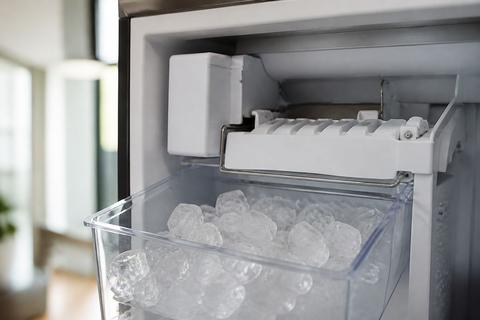
Whirlpool Ice Maker Making Small Cubes? Fixes and Causes
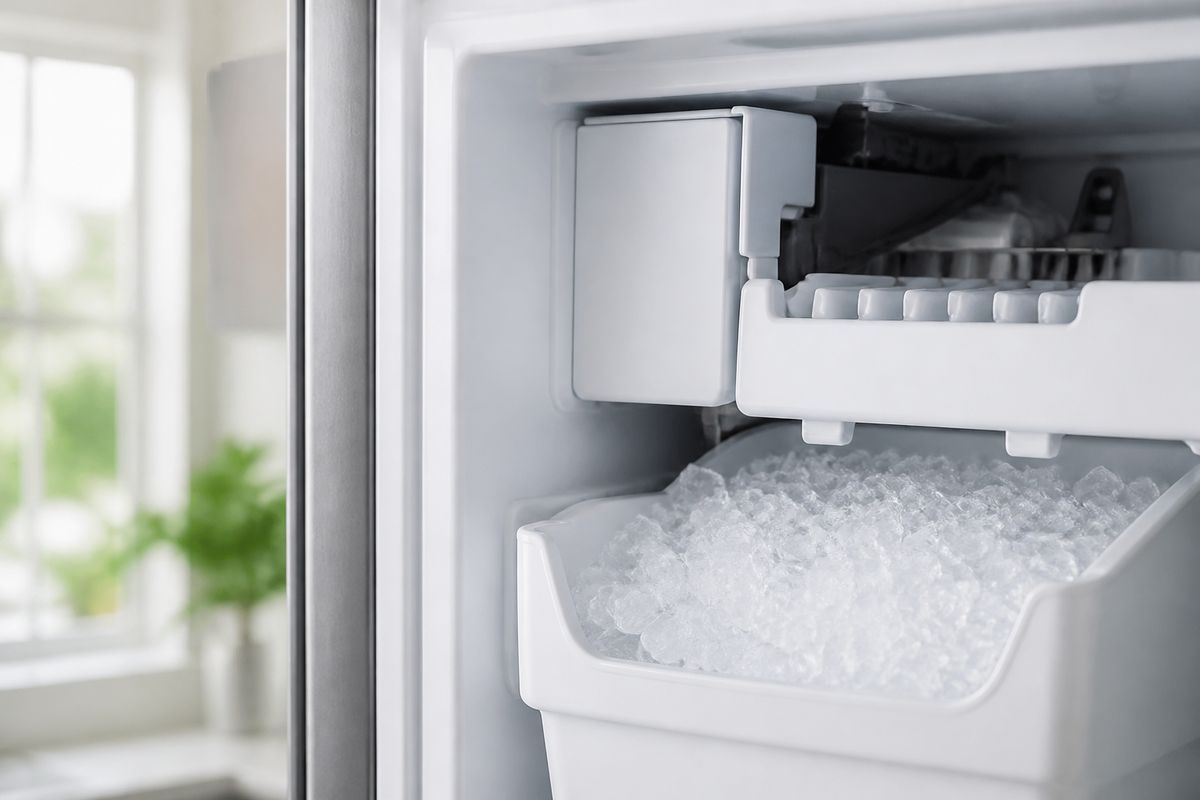
If you’re dealing with a whirlpool ice maker making small cubes, the problem is almost always water flow or the fill/harvest cycle—not “bad ice.” Small cubes can mean the ice maker isn’t filling the mold fully, while hollow cubes point to an incomplete water fill. Get your ice back to normal by checking the water path first, then the freezer and the harvest components.
For more help, see our Whirlpool Ice Maker Cleaning and Maintenance guide.
Start with the most common causes
When Whirlpool ice makers make small cubes, the most common cause is restricted water flow into the ice mold. Start by inspecting the simplest items that affect fill volume before moving to sensors or modules.
Check the water supply and shutoff valve
A partially closed shutoff valve or interrupted supply reduces the amount of water entering the mold. Do this:
- Pull the refrigerator forward slightly and locate the inline water shutoff valve behind it.
- Turn the valve fully counterclockwise to open it (if it’s a lever, move it so it’s fully open).
- Run a nearby cold-water faucet for 30 seconds; water should flow strongly and steadily.
- If your home has a filter system upstream, ensure it isn’t clogged and that the water line is fully connected.
Inspect the inlet water filter for clogs
A clogged filter restricts water flow and directly causes underfilled or undersized cubes. Replace/inspect the filter if it’s overdue:
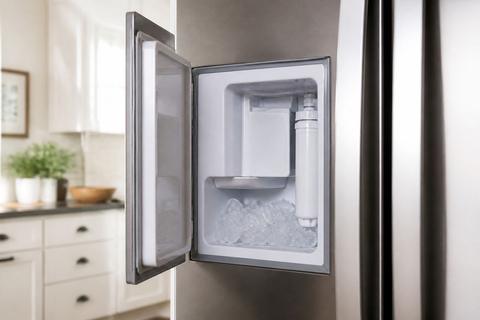
- Find the refrigerator water filter (often a cartridge in the grille or inside the compartment).
- If it’s near or past the recommended interval (many Whirlpool filters are rated about 6 months / 200 gallons), replace it.
- After installing the new filter, discard the first 2–3 full ice batches, especially if the filter was recently changed or the fridge was recently installed.
- After replacement, watch the next batch size; restricted flow typically improves immediately once water flow restores.
Look for low household water pressure
Even with a good filter, low household pressure can starve the ice maker’s fill cycle. Whirlpool’s typical supply spec is roughly 35–120 psi:
- If you have access, check your home’s water pressure with a gauge on a cold-water line.
- If you don’t have a gauge, look for clues: slow kitchen faucet flow or water pressure that drops when another tap runs.
- If pressure is low at the home, address it at the plumbing level (pressure regulator/municipal supply), because an ice maker can’t compensate.
- If pressure is normal, move to the inlet valve/fill tube checks next.
Why ice cubes come out small or hollow
Small or hollow cubes usually come from incomplete filling of the ice mold. The fix is about restoring proper water quantity and freezing conditions so the water forms full cubes.
Rule out temperature issues in the freezer
Freezer temperature affects how well the mold freezes the water after filling. If the freezer runs warm, cubes can come out incomplete or undersized.
- Check the freezer temperature setting and adjust to 0–5°F.
- Use an appliance thermometer for accuracy if the display seems unreliable.
- Confirm the freezer door seals well and isn’t being left open or blocked by large items.
- Allow at least 6–12 hours for the freezer temperature to stabilize before judging cube size again.
Inspect the water inlet valve and fill tube
The inlet valve controls how long water flows into the mold. A failing valve or restricted fill path underfills the mold.
- Unplug the refrigerator (or switch off the ice maker if your model has a dedicated switch).
- Locate the thin fill tube that routes water to the ice mold.
- Check for kinks, cracks, or obvious blockage.
- If water flow seems weak during fill (only a small dribble into the mold), the inlet valve or tubing is the likely restriction.
Check for mineral buildup or partial freezing
Minerals can narrow passages, and partial freezing can stop water from reaching the mold at the right time. This often produces hollow or tiny cubes.
- Look for crusting on fittings or around the fill tube connection points.
- If the fill tube or its line feels cool/frozen, thaw it.
- Use a hair dryer on a low/medium setting aimed at the frozen section for a few minutes (avoid overheating plastic).
- Once thawed, run a cycle and observe whether the mold receives full water.
Verify the ice maker is level and seated correctly
If the ice maker sits crooked or slightly loose, the mold may not fill or dump correctly. Inline and modular models rely on correct alignment.
- Ensure the ice maker assembly is fully seated in its mounting position.
- Use a small level on top of the ice maker housing.
- If the housing is tilted, reseat it firmly and re-check the mounting bracket area.
- After reseating, allow the next batch to run; misalignment can cause repeat undersized cubes.
When the ice maker makes few cubes or no ice at all
Few cubes or total no-ice points to a harvest-cycle interruption or an ice maker control issue. Work through power, water entry, and mechanical signaling.
Confirm the ice maker is switched on
A turned-off ice maker produces no ice regardless of water supply.
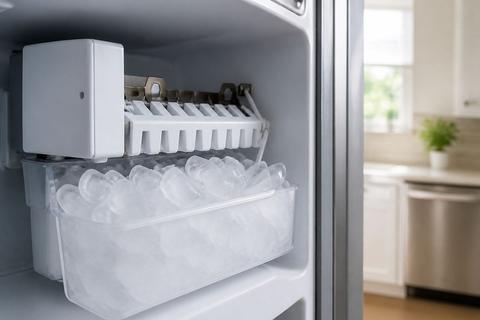
- Locate the ice maker on/off control: many Whirlpool models use a wire feeler/shutoff arm or sliding feeler paddle.
- Lift the arm/feeler to the OFF position to confirm it moves freely, then lower it to the ON position.
- If your model uses a switch inside the ice maker housing, set it to ON.
- Wait for the first harvest after switching on; it takes time for cubes to freeze.
Test the ice maker arm, shutoff, or sensor
If the ice maker thinks the bin is full, it stops making ice. Some models use an arm or sensor in the bin.
- Inspect the ice maker’s shutoff mechanism for obstructions (frozen ice or a stuck arm).
- Manually move the arm/sensor through its range; it should move smoothly without binding.
- If it feels stuck, check for a frozen clump between the mold area and the bin.
- After clearing, confirm the arm returns to the correct ON position and stays there.
Check the mold thermostat and module for failure
When water fills but the unit doesn’t complete freezing/harvest, the mold thermostat and control module become suspect.
- If your model has diagnostic information on the display, note the code and follow the manufacturer symptom meaning.
- For modular Whirlpool ice makers, inspect for signs of failed components (burn marks, severe corrosion, or connector damage).
- If the ice maker never starts a harvest cycle after water is present, a module/thermostat failure is a common cause.
- At this point, plan for a parts test or service because correct component testing requires measurements.
Know when a reset may help
A reset can restore operation after a power interruption or temporary control fault. It won’t fix water restriction, but it can clear a stuck control state.
- Unplug the refrigerator for 1 minute, then plug it back in.
- If your model uses an ice maker power switch, leave the ice maker ON after power returns.
- Allow 24 hours for production to return to a normal pace; ice makers need multiple cycles to catch up.
- If there’s still no ice, skip repeated resets and focus on water fill and harvest signals.
If the ice maker fills but will not dump ice
If the mold fills but ice won’t eject, you’re dealing with a harvest obstruction or a drive/mechanical failure in the ejector path.
Remove ice jams in the bin or ejector blades
A jam can stop the ejector from moving ice out of the mold. Keep the bin area clear so the harvest cycle can finish.
- Remove the ice bin and empty it.
- Look for ice buildup around the ejector area and remove loose ice by hand (use a towel for grip).
- Inspect the ejector blades and the path ice travels; clear any clumps that prevent movement.
- Reinstall the bin firmly so the ice maker can detect correct seating.
Free a stuck rake, arm, or motor
A stuck rake/arm can prevent ice from releasing from the mold, even with normal water fill.
- Unplug the refrigerator before reaching into the ice maker mechanism.
- Check the rake/arm for frozen contact points or mechanical binding.
- If the rake area is frozen, thaw the ice maker housing area with gentle warmth until ice releases.
- If the mechanism moves freely by hand but the motor still doesn’t cycle, the motor/module may be failing.
Examine the door switch and dispenser path
If you have a dispenser that controls ice serving, a failed door switch or blockage can also prevent normal ice movement patterns.
- Check the dispenser area for ice blockage along the chute.
- Verify the dispenser door switch is making proper contact (no mechanical sticking).
- Look for buildup that prevents the dispenser from opening fully.
- If the ice maker still harvests but dispensing never proceeds, focus on dispenser components and chute clearance.
Replace worn parts that no longer cycle
Worn gears, broken ejector components, or failed drive modules can stop harvest completion. Replacement is often the fastest path once mechanical tests confirm movement failure.
- If the ejector/motor hums but doesn’t rotate, inspect the coupling and ejector assembly.
- If the rake stops mid-cycle repeatedly, inspect gear engagement and actuator components.
- Replace parts based on your model’s parts list to match the exact ice maker type.
- After replacement, allow about 24 hours for the ice maker to return to normal batch timing.
Simple fixes you can try before calling for service
Some quick actions correct the majority of performance issues, especially when small cubes/hollow cubes come from trapped frost, restricted flow, or early-cycle water issues.
Defrost the ice maker area safely
Frozen fill lines or ice buildup can block water or harvest. Thawing restores normal flow and movement.
- Unplug the refrigerator to stop the ice maker.
- Allow the ice maker area to warm briefly; for faster thawing, use a hair dryer on low/medium heat.
- Direct heat at the suspected frozen section (commonly the fill tube/mold area), not any plastic near the power components.
- Once ice melts and water flow looks normal, plug the refrigerator back in and let the ice maker run.
Replace the water filter if it is overdue
An overdue filter is one of the fastest ways to resolve undersized/hollow cubes caused by restricted water flow.
- Replace the filter with the correct Whirlpool-compatible cartridge.
- Run water through the dispenser if your model prompts priming.
- Discard the first 2–3 full batches of ice after replacing the filter.
- Watch the next one to two batches for a return to normal cube size.
Clean the fill tube and ice mold
Buildup in the mold or fill tube can reduce water delivery and cause repeat small or hollow cubes.
- Unplug the refrigerator.
- Carefully access the ice mold area and remove visible ice chunks.
- If mineral deposits are present, clean with warm water and non-abrasive tools (avoid damaging plastic).
- Clear and re-seat the fill tube connection if it was loosened during cleaning.
Run a full test cycle after repairs
Once you restore water flow or remove jams, a full cycle confirms the ice maker completes harvest properly.
- After clearing blockages or defrosting, allow the unit to begin its normal cycle.
- If your model supports a test mode, use the test button/menu path from the refrigerator’s manual.
- For modular Whirlpool ice makers, some models use a manual harvest approach with test holes on the module when power is off; follow your specific model’s test procedure precisely.
- Observe whether the next harvest fills the mold properly and dumps ice into the bin.
When to replace the ice maker or get help
If water flow is good, freezer temperature is correct, and jams/mechanics are cleared, the remaining failures usually involve control electronics or internal drive components. At that point, replacement or professional diagnostics can be more cost-effective than repeated parts guessing.
Signs the valve, motor, or module has failed
When key symptoms persist, failed components are likely.
- Water never enters the mold despite a confirmed open valve, normal pressure, and a new/clean filter.
- Water enters the mold but the harvest never completes across multiple cycles.
- The ejector motor hums or stops mid-cycle repeatedly with clear mechanical pathways.
- Error codes persist on the display and correspond to ice maker hardware failures.
When repair costs do not make sense
Replacing the ice maker is sometimes the best value when symptoms point to multiple failed components.
- If the control module and motor/harvest components require replacement together, costs rise quickly.
- If the unit is older and multiple parts have already been replaced, a new ice maker often becomes the practical solution.
- If labor plus parts approaches replacement pricing, choose replacement to reduce repeat downtime.
- If you need guaranteed parts matching, professional service can prevent mismatched component issues.
Frequently Asked Questions
Why is my Whirlpool ice maker making small cubes?
The most common causes are low water flow, a clogged filter, a partially blocked fill tube, or freezer temperatures that are too warm. A weak inlet valve can also underfill the ice mold.
Why are my ice cubes hollow?
Hollow cubes usually mean the ice maker is not getting enough water during the fill cycle. Check the filter, water pressure, inlet valve, and any kinks or freezing in the fill tube.
Why won’t my ice maker dump the ice?
A stuck ejector, frozen ice in the mold, a failed motor module, or a jammed bin can stop the harvest cycle. Sometimes thawing the ice maker and clearing the bin solves it.
Why did my refrigerator stop making ice cubes?
Possible reasons include a turned-off ice maker, water supply interruption, clogged filter, failed inlet valve, or a bad control module. Start with the water supply and freezer temperature.
Can a dirty water filter cause small ice cubes?
Yes. A clogged filter can restrict water flow enough to produce undersized or hollow cubes, slow filling, or no ice at all.