GE Ice Maker Keeps Defrosting: Causes, Fixes, and Settings
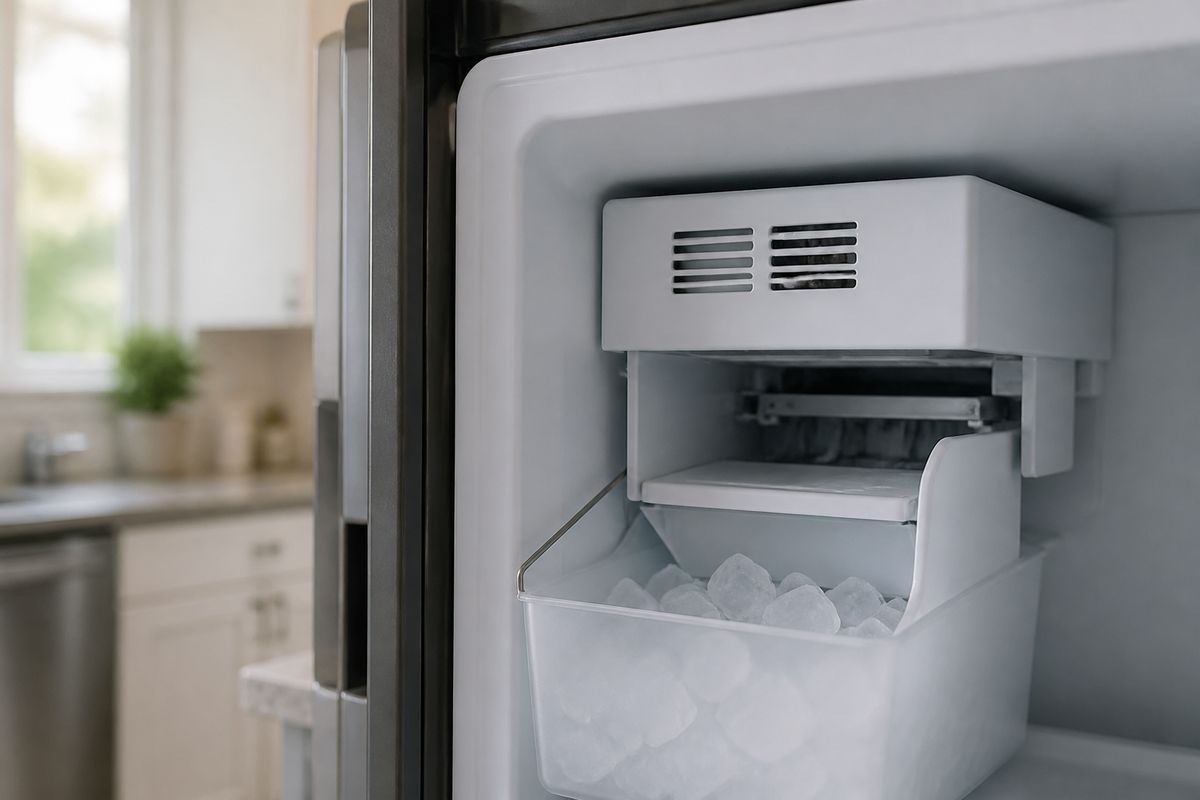
If you’re dealing with ge ice maker keeps defrosting, you’re probably seeing frost melt off the ice maker area, the unit pause/heat cycles repeatedly, or ice production slow down fast. That repeated warming can happen when the system thinks it’s time to clear frost—or when something prevents proper freezing. Before you schedule service, work through the settings, airflow, water supply, and the ice maker’s defrost components in order.
For more help, see our GE Ice Maker Defrost and Freeze-Up Fixes guide.
Why Your GE Ice Maker Keeps Defrosting
How the defrost cycle works
GE ice makers use a timed or sensor-driven defrost cycle to clear frost and let ice sheets release from the evaporator/ice-forming surface. During defrost, a heater warms the ice-making area so ice can release cleanly into the bin. If defrost triggers too frequently, the ice maker may be failing to reach or maintain the freezing temperature long enough to build consistent ice. The most common causes are a temperature/airflow problem, restricted water flow that prevents ice formation, or a sensor/control issue that falsely reports “frost” or “full release.”
Common signs the ice maker is warming up too often
Look for repeated heater activity even when the freezer contents haven’t changed. Clear signs include: ice production drops noticeably, you see water pooling or refreezing on the ice maker surfaces, and the area around the ice maker looks frosty in a patchy pattern followed by melting. You may also hear a distinct warming/defrost sound repeatedly in a short span of time. On some GE modular systems, the ice maker may cycle more often and the bin level/feeler arm behavior can feel inconsistent because ice is not building reliably.
When the problem is in the ice maker vs. the refrigerator
Pinpoint the source by separating “ice maker can’t freeze” from “freezer isn’t staying cold.” If other freezer functions are unstable—soft items, frequent warm-air drafts, or the freezer setpoint is off—focus on the refrigerator first (temperature and airflow). If the freezer maintains proper temperature but the ice maker still repeatedly enters defrost, the likely issue is within the ice maker itself: sensors, thermostat/heater circuit, control board logic, or a frozen/restricted airflow path inside the ice maker.
Check the Settings and Control Panel First
Verify that vacation mode, demo mode, or Sabbath mode is off
A mode that reduces cooling, pauses cycles, or changes how the control responds can lead to abnormal ice maker behavior, including frequent defrost activity. On your GE refrigerator, check the control panel settings for Vacation Mode, Sabbath Mode, or Demo Mode and turn them OFF. If you recently enabled one of these while cleaning, during travel, or for showroom display, switch back to normal operation immediately, then allow the freezer temperature to stabilize.
- Press Settings (or Options, depending on the model).
- Select Vacation Mode, Sabbath, or Demo Mode.
- Set each one to Off.
- Leave the refrigerator on normal mode for the ice maker to re-enter its standard cycle.
Confirm the ice maker is enabled and the bin sensor is clear
If the ice maker thinks the bin is full—or if the bin sensor/feeler arm is obstructed—it can behave erratically and cycle in unexpected ways. Make sure the ice maker is actually enabled and the ice bin area is free. On many GE models, the wire bail/feeler arm stops the ice maker when raised; if it’s stuck up, the ice maker won’t reliably harvest and may keep cycling.
- Locate the ice maker shutoff feeler arm (wire bail) inside the freezer.
- Lower the arm fully if it’s raised or blocked by items.
- If your model has an ice maker power switch, slide it to ON.
- Remove any ice chunks blocking the sensor area, then close the bin correctly.
Adjust freezer temperature to the recommended range
A freezer set too warm is one of the fastest ways to cause frequent defrost-like behavior because ice cannot hold formation. GE ice makers need a cold environment to freeze properly. Set the freezer to 0°F (-18°C) (or GE’s recommended freezer setting for your model). If the freezer is running warm due to blocked vents or a newly loaded warm-cold area, the ice maker may repeatedly warm/freeze without producing stable ice.
- Open the freezer and check the temperature display.
- Set the freezer to 0°F (-18°C).
- Ensure no items block the air vents in the freezer back wall.
- Wait for the freezer to reach the new setpoint before judging cycle frequency.
Inspect the Water, Ice, and Airflow Path
Look for a clogged fill tube or frozen water line
Even if the ice maker runs and enters defrost, it can keep doing so when water can’t reach the ice-forming area. Inspect the water path for freezing and restriction. A partially frozen water line or a clogged fill tube prevents proper ice formation, which can lead to repeated cycling.
- Unplug the refrigerator or switch off ice maker power.
- Inspect the inlet water line and fill tube for kinks and ice.
- If you see frosting at the line connection or inside the fill tube area, thaw the frozen section safely and eliminate the cause of freezing (warm air leaks, poor airflow).
- Restore power and watch for normal refill after the next cycle.
Clear frost or ice buildup around the ice maker
Excess frost outside the intended ice-making surfaces can trap heat and force abnormal release/defrost timing. Carefully remove buildup so air can move and the ice maker can sense properly. Do not chip aggressively—use gentle removal to avoid damage to sensors or heater surfaces.
- Unplug the refrigerator and remove the ice bin.
- Use a soft cloth or plastic tool to remove loose frost/ice from the ice maker housing area.
- Check for ice bridging around the ice chute/harvest path that can block movement.
- Reinstall the bin and restore power.
Make sure vents and door seals are not letting warm air in
Warm air inflow increases frost formation and destabilizes freezing, which can indirectly cause repeated defrost cycles. Start by checking both the freezer door seal and the internal vents that route cold air to the ice maker area.
- Close the freezer door on a strip of paper; if it slips out easily along the perimeter, the seal may leak.
- Look for gaps in door gasket contact—especially at corners.
- Confirm vents inside the freezer are not blocked by food containers or bags.
- Reposition food to keep the ice maker and vent area clear.
Fix Common Mechanical and Electrical Causes
Reset the ice maker or power cycle the refrigerator
A reset forces the control to clear a stuck state and start a clean cycle logic. For many GE units, a full power cycle is the most reliable reset because it clears timing faults that keep the system repeatedly warming.
- Switch off the ice maker (if your model has an ice maker switch).
- Unplug the refrigerator for 30 seconds to 5 minutes, then plug it back in.
- Turn the ice maker back ON.
- Allow the ice maker to begin a harvest cycle under normal operating conditions.
Check the thermostat, heater, and control board
If defrost runs too frequently, the defrost heater circuit or the sensing/control feedback may be failing. The thermostat/sensor can misread frost level or temperature, causing premature or repeated defrost activation. The control board may also be incorrectly commanding heater operation if it receives faulty readings.
- Inspect wiring connectors at the ice maker (look for looseness, corrosion, or damaged insulation).
- Check for signs of overheating or burnt odor near the heater connections.
- If you can access the ice maker diagnostics, look for any fault codes on the display (some GE models show service indicators).
- If the heater is commanding defrost at the wrong times or the sensor readings don’t match reality, schedule parts diagnosis (thermostat/sensor, heater, and control/board).
Inspect the auger, motor, and sensors on GE Opal models
On GE Opal nugget ice makers (the countertop units), repeated heating/defrost-like behavior is commonly linked to cleaning needs or internal sensor/reservoir conditions. The motor/auger harvest path also matters: if ice can’t move correctly, the unit may not complete cycle logic.
- Unplug the Opal for a full 5 minutes.
- Restart and run the unit through its Clean cycle if it hasn’t been cleaned recently.
- Check that the water reservoir/side tank is seated correctly and has water.
- If you see flashing indicator patterns, follow the Opal’s error meaning (often cleaning needed or reservoir low/empty).
Model-Specific Fixes for GE and Other Brands
GE Opal units stuck in defrost mode
If your GE Opal appears to remain in a heating/clearing state instead of producing ice normally, do a reset and follow the machine’s cleaning routine. Scale buildup can disrupt sensor readings and slow heat transfer, which can make the unit cycle improperly.
- Unplug the Opal for 5–10 minutes.
- Restart the unit and immediately run a Clean cycle from the menu (or the CLEAN button, depending on model).
- Use Opal Nugget Ice Maker Cleaner (recommended) or a vinegar-water solution per cleaner instructions.
- After cleaning, run a rinse cycle or dispense cycles so residual cleaner is fully purged.
What to check on Frigidaire Gallery, LG, KitchenAid, and Samsung ice makers
Across brands, repeated warm-up cycles usually tie back to one of four areas: incorrect freezer temperature, restricted water delivery, a faulty ice level sensor/thermistor, or abnormal frost/airflow. Start with the basics that change cycle behavior. For built-in refrigerator ice makers, verify the freezer is at proper ice-making temperature and that the water filter isn’t clogged.
- Set freezer temperature to 0°F (-18°C) (or the manufacturer’s ice maker spec).
- Replace the water filter if it’s past service life (a clogged filter reduces flow and disrupts ice formation).
- Check for ice buildup around the ice chute and in the ice maker housing.
- If the unit has a clean/filter light or fault code, clear and address the cause before cycling again.
When a replacement part is the better option
If water and temperature are correct and the ice maker repeatedly enters defrost without producing stable ice, replacement parts can be the efficient fix. The most common parts that affect defrost timing are the thermostat/thermistor (temperature sensor), defrost heater, and control board. On Opal countertop units, replacing components is less common than doing a proper cleaning/descaling and verifying reservoir functions, but sensor or control failures still happen.
- If diagnostics show heater/sensor faults or defrost occurs with no frost accumulation, plan on sensor/heater testing.
- If wiring looks intact but the cycle logic stays stuck, the control board is the next likely cause.
- If repair access is complex or parts are costly, compare repair pricing to replacement cost.
- Use genuine parts matched to your exact model number to avoid incompatibility.
Prevent the Problem From Coming Back
Keep the freezer at the right temperature
Consistent freezing prevents excess frost and stops false triggers that push repeated defrost cycles. Maintain your freezer around 0°F (-18°C) so the ice maker reaches temperature quickly and stays stable throughout the day. Temperature swings happen when the door is opened too often, vents are blocked, or warm air leaks past the gasket.
- Set and maintain 0°F (-18°C).
- Keep vents unobstructed and avoid stuffing the freezer tightly against the back wall.
- Minimize door open time and check gasket contact.
- After large grocery loads, allow extra time for the freezer to return to setpoint.
Clean the ice maker regularly
Scale and mineral deposits slow heat transfer and can throw off sensor behavior, especially on nugget ice systems. Cleaning removes buildup that causes the unit to cycle through warming/defrost more aggressively to achieve the release temperature.
- Follow your model’s cleaning interval (use the manufacturer schedule).
- For GE Opal, run the Clean cycle and use Opal Nugget Ice Maker Cleaner (or an approved vinegar-water solution).
- Rinse and dispense after cleaning to clear any residue.
- Wipe accessible exterior surfaces and remove ice debris from seams and around the bin.
Reduce moisture and warm-air leaks in the freezer
Moisture and warm air feed frost growth and make the ice maker’s environment unstable. Fixing moisture sources prevents the system from trying to “catch up” by cycling more heat and defrost.
- Check freezer door seals for gaps and clean gasket surfaces so they seal tightly.
- Avoid leaving containers uncovered that release moisture into the freezer air.
- Ensure airflow isn’t blocked by large items or poorly arranged bins.
- Address refrigerator leveling issues that can affect door closure and gasket compression.
Frequently Asked Questions
Why does my GE ice maker keep going into defrost mode?
The most common causes are a settings issue, a faulty sensor, a control board problem, frozen airflow passages, or a temperature issue in the freezer.
How do I reset a GE Opal ice maker that is stuck in defrost?
Start with a full power cycle by unplugging the unit for several minutes, then restarting it. After reboot, check the cleaning state and mode conditions; if it still stays in defrost, the sensor or control board may need service.
Can a warm freezer cause the ice maker to defrost too often?
Yes. If the freezer is too warm or has poor airflow, the ice maker can’t freeze properly, and the cycle may repeatedly shift into warming/defrost behavior instead of building consistent ice.
What temperature should a freezer be for an ice maker to work properly?
A freezer should generally stay around 0°F (-18°C) for reliable ice production and to prevent excess thawing.
Is this usually a repair I can do myself?
Many causes are DIY-friendly, such as checking settings, cleaning vents, clearing ice buildup, and verifying temperatures. If the control board, thermostat, or heater is failing, professional repair is often the safest option.